Market Update — June 2026

We firmly believe timely and relevant data is key to making good decisions. To this end, we are committed to providing our community and clients with actionable data and insights about the local real estate market.
Local real estate market
With the data from May 2026 in, here’s an overview of the key aspects of the local real estate market. The real estate data below is collected from Northwest Multiple Listing Service (NWMLS).
Median price: The chart below shows the latest median sales prices of homes over the past 5 years in the Greater Seattle area over the past five years:
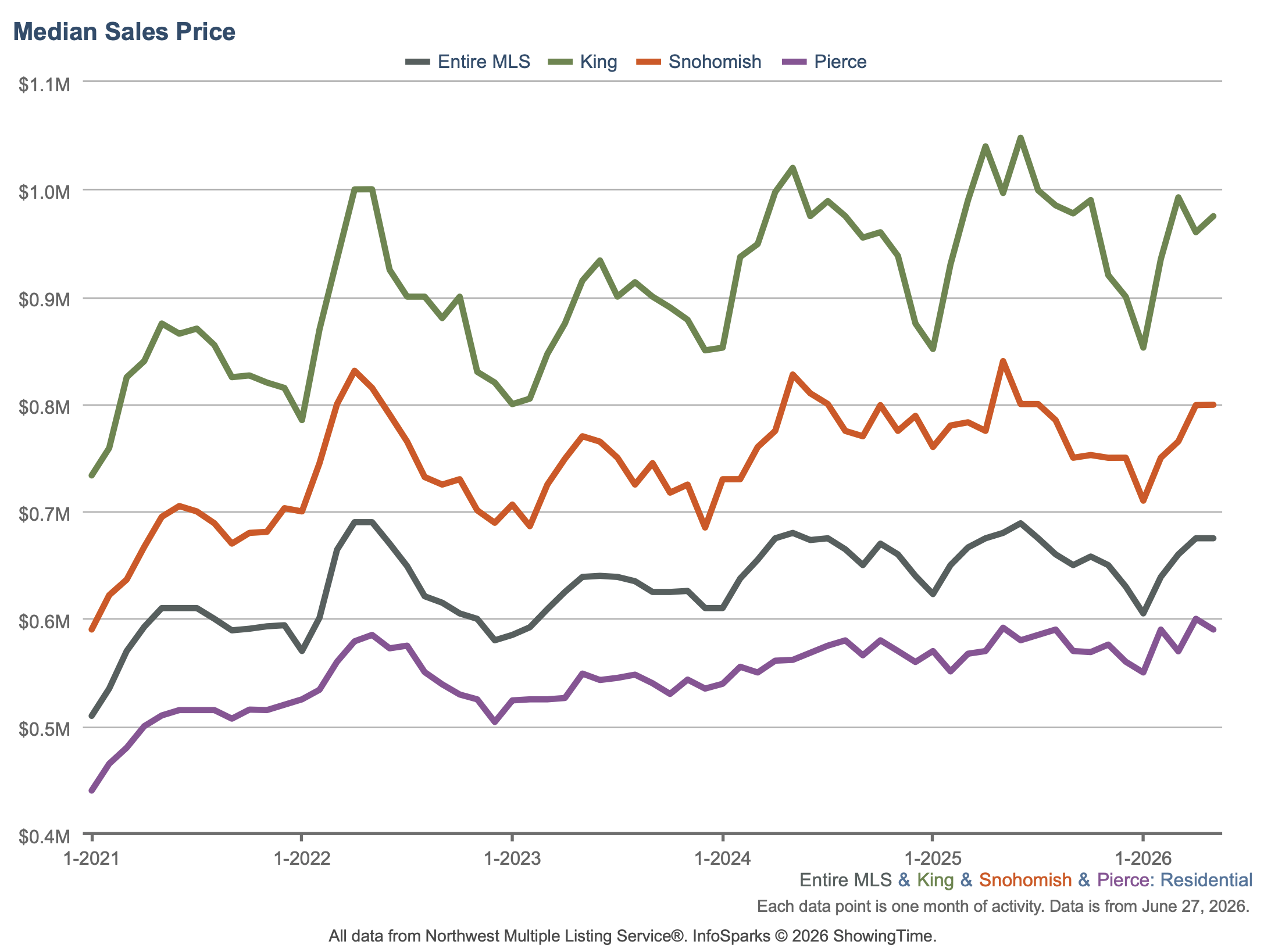
Homes sold: 6,213 homes were sold in May 2026, which is about the same YOY (6,467 in May 2025). The median price of $650,000 showing no change YOY. This total sale volume translates to a dollar value of about $5.1B.
Months of inventory: Given the current quantity of supply, it’ll take 3.44 months for every listed home to sell. To put this number in perspective, note that the months of inventory for a balanced market is considered to be 4 to 6 months.
Median price: CountyThe counties with the highest median sales prices were San Juan ($1,125,000), King ($875,000), and Snohomish ($759,875), while the lowest median prices were recorded in Adams ($309,000), Okanogan ($327,000), and Grays Harbor ($369,000).
New listings: 12,562 new listings were added to the NWMLS database in May 2026 representing a YOY decrease of 4.3%.
Mortgage rates: The Freddie Mac rate has shown no significant monthly change.
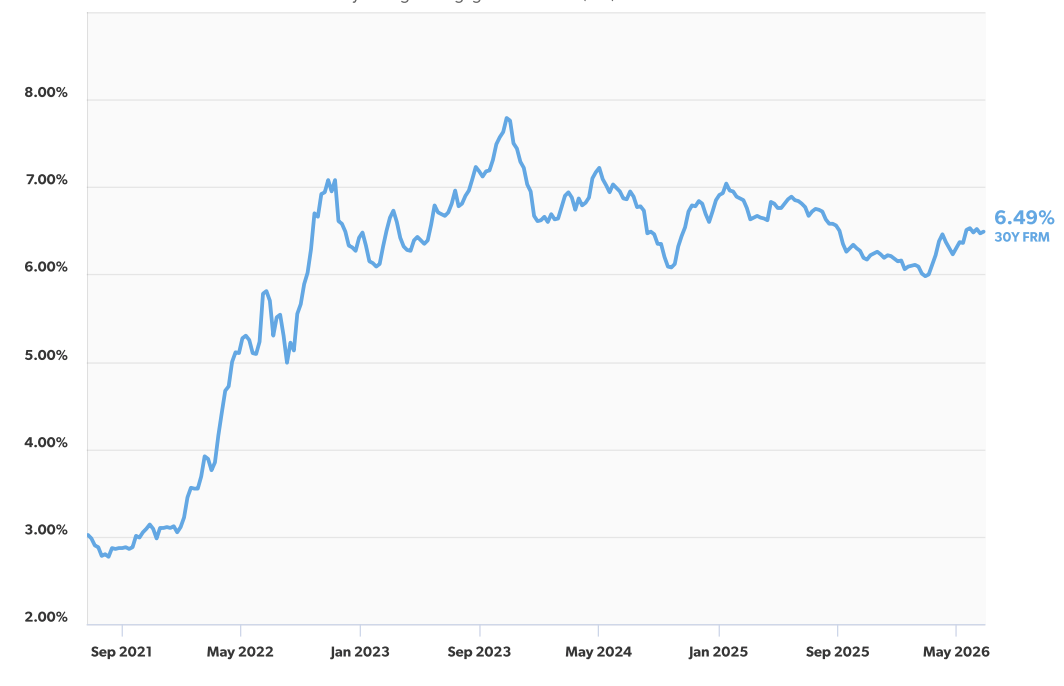
Primary Mortgage Market Survey — Average 30-Year Fixed Mortgage Rates over the past 5 years (Source: Freddie Mac)
Broader U.S. economy
Fed Leaves Rates Unchanged: In Kevin Warsh’s first meeting as Fed Chair, the Federal Reserve unanimously voted to leave its benchmark Federal Funds Rate unchanged at 3.50% to 3.75%. This marks the fourth consecutive meeting without a rate change following cuts late last year. While the Federal Funds Rate does not directly set mortgage rates, it influences borrowing costs throughout the economy and can affect the overall interest rate environment.
Housing Construction Slows as Builders Remain Cautious: The pace of new home construction slowed sharply in May. Housing starts, which measure new homes breaking ground, fell 15.4% from April to an annual rate of 1.18 million units – the lowest level since 2020 and well below expectations. Building permits, a key indicator of future construction activity, also edged down 0.7% to an annual rate of 1.413 million units, largely in line with forecasts. Builders continue to take a cautious approach. The National Association of Home Builders’ Housing Market Index slipped two points in June to 35. Any reading below 50 indicates that more builders view market conditions as poor than good. Affordability challenges, elevated mortgage rates, and higher construction costs remain key concerns.